

"Drawing with Thread"
Lee Shinja at the Berkeley Art Museum and Pacific Film Archive

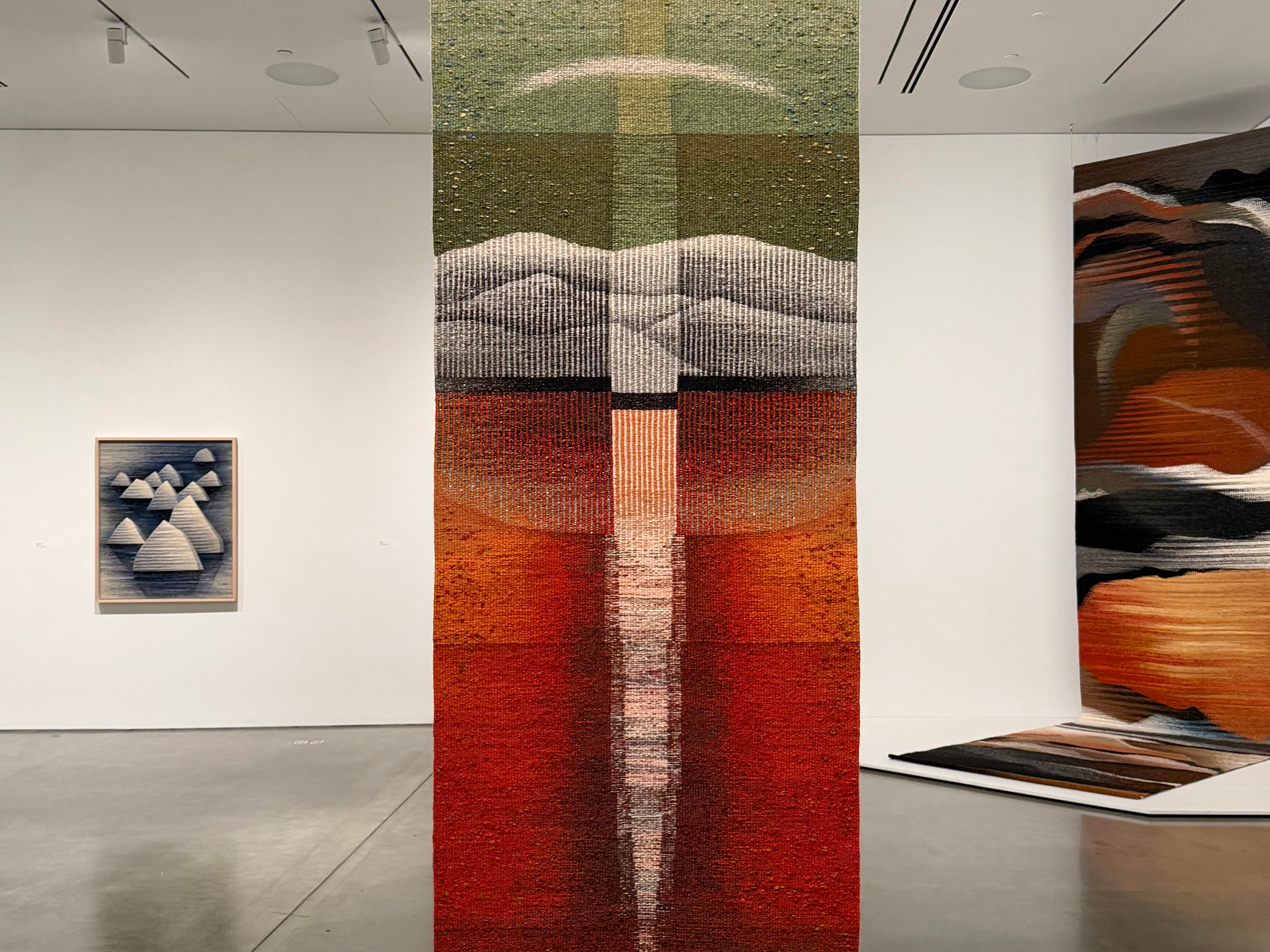
A thread of animacy runs through Lee Shinja’s monumental tapestries at the Berkeley Art Museum and Pacific Film Archive. Drawing With Thread, the artist’s first solo retrospective outside of South Korea, showcases Lee’s artistic evolution over a career spanning five decades through forty textile works. As I wend my way through the galleries, I am mesmerized by iridescent shimmers of light and feathery streaks of color—violet, crimson, aquamarine, moss green—that beckon me closer like undulating waves. Lee frequently hand-dyed these vivid fibers herself, using wool from unraveled sweaters or other everyday objects she found at secondhand stores and markets.
Born in 1930 in the coastal county of Uljin, South Korea during the Japanese occupation, Lee’s career bears traces of South Korea’s own modern history. Her use of recycled materials reflects the economic hardships South Koreans endured following Japanese colonialism and amidst the Korean War. In 1950, Lee matriculated at the prestigious Seoul National University, but due to the breakout of the war, was forced to relocate to Busan where she continued her studies at the Wartime Nations University. Though she is now regarded as an innovator and pioneer of fiber art in South Korea, Lee first began experimenting with embroidery and weaving when textile work was still largely regarded as a form of domestic labor.
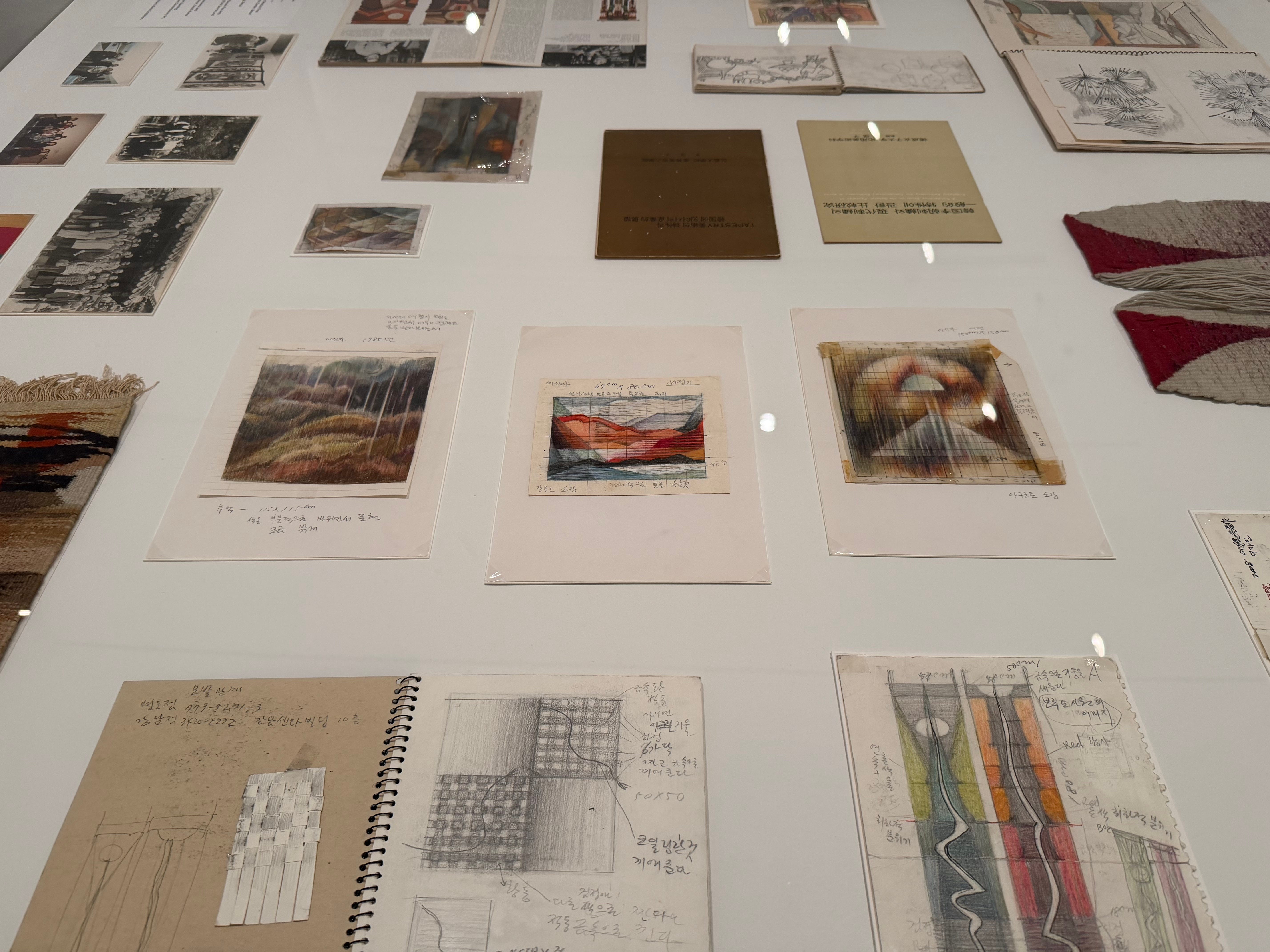
A display case of notebooks and maquettes anchors the first gallery of the exhibition, offering an intimate view of fragments from Lee’s life and community. A collection of photographs catalogues the progression of her career, indexed by her brushes with other prominent artists in Asia, including Korean painter Park Seo-bo and Japanese designer Issey Miyake, among others. Sketchbook spreads and textual ephemera locate Lee’s movement through various institutional spaces, from Duksung Women’s University, where she taught for more than thirty years, to the Museum of Modern and Contemporary Art in Seoul.
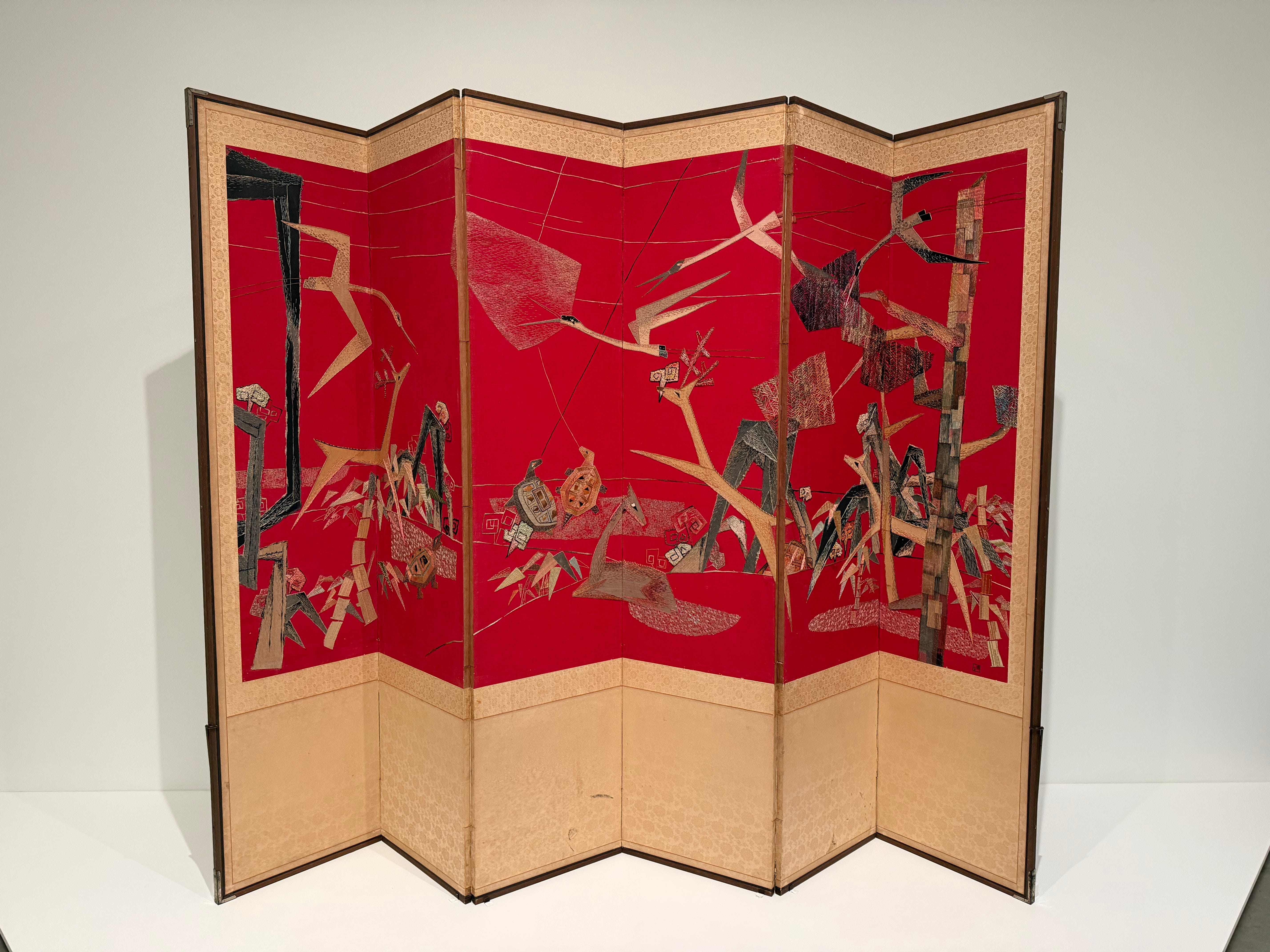
When she first began exhibiting her work, Lee’s innovative approach to textile art appalled many Korean viewers, with some even suggesting that she “wove with her feet.” Lee’s early embroidered works subverted familiar techniques in both Western and Korean art, producing the illusion of three-dimensional depth against two-dimensional figuration. In Portrait of My Daughter (1962), tight coils of cotton and wool threads coalesce into a fragmented representation of a child-like face, recalling the geometrical forms of Cubism. Across the room in Ten Longevity Symbols (1958), Lee riffs on a traditional landscape painting motif from the Joseon Dynasty. Her simplified, abstract style lends the ten symbols a visage of liveness absent from their historical antecedents. On Lee’s embroidered screens, cranes swoop, deer leap, and tortoises angle their necks up towards the sky. Glossy threads shimmer like a raven’s feathers, offering a sheer luster that gives the image a three-dimensional quality despite its apparent flatness.
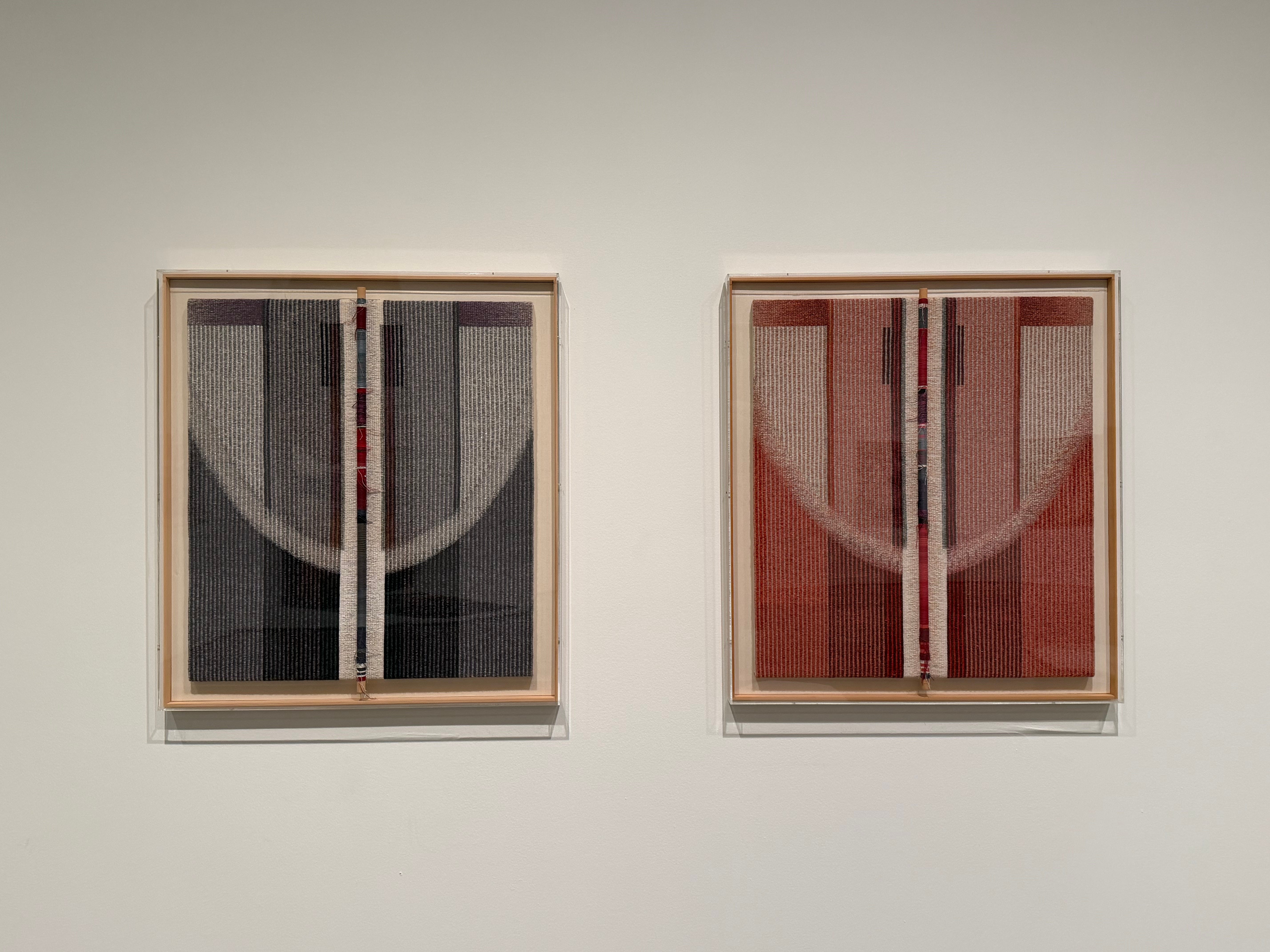
In her later work, Lee increases the scale of her tapestries to evoke the monumentality of nature. She cites visions from her childhood of the sun rising and setting along the horizon as a significant source of inspiration. In Korean, there is a word for the way light shimmers across the surface of the ocean—yoon-seul (윤슬). Traces of this ephemeral beauty are woven into Lee’s work. Rolling layers of earth-toned hues evoke cresting waves in Dawn (1987), and metallic threads add a subtle shine to the fabric’s warp and weft in Prayer III and Prayer IV (2007), imbuing Lee’s tapestries with an illusion of motion that suspends their stillness.
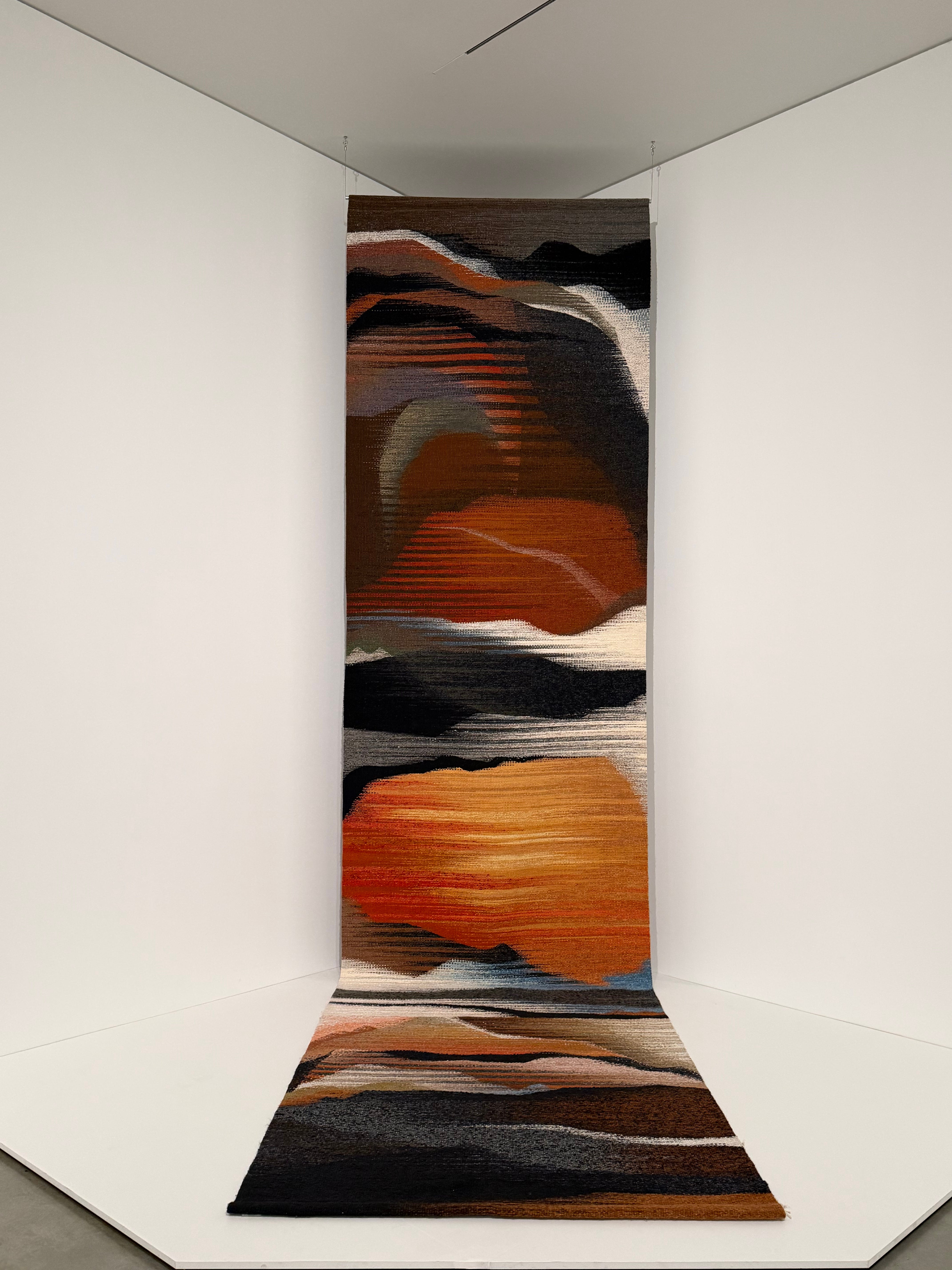
However, her most personal and visually provocative works are perhaps a series of vibrant red and black tapestries Lee created following the death of her husband, painter Chang Woon Sang, in 1982. In these weavings, Lee reflects on the cycles of life and death through sculptural tapestries that set weeping crimson against a deafening black backdrop. In Echo (1985), a brilliant blood-orange celestial motif recedes and is overtaken by darkness over a series of five vertically elongated tapestries, emulating the inevitable passage of time through the movement of the stars. Red-orange tassels emerge from a black abyss in Sprouting (1985) and splatter dramatically onto a white platform below, as explosive as a gush of blood from a wound. Bereavement, too, seems integral to Lee’s meditations on life and death; in 88 Harmony (1988), the final work of the series, black tendrils ominously conceal bright red flashes in a stunning rendering of the sharp pain of grief.


The force of Lee’s tapestries lies in her transformation of tragedy into beauty with her meticulous, visionary craftsmanship. Despite the loss implicit in the national and personal histories that linger beneath her woven works, Lee portrays a radiant world teeming with life. As with nature, I discover newfound appreciation for her work up close. Edging closer then backing away, shifting from left to right, I find that the shine and detail of her soft surfaces reveal themselves most clearly when I revolve around the tapestries as though I too were a celestial body.