

Asian Abundance
Field notes from my first semester at Berkeley

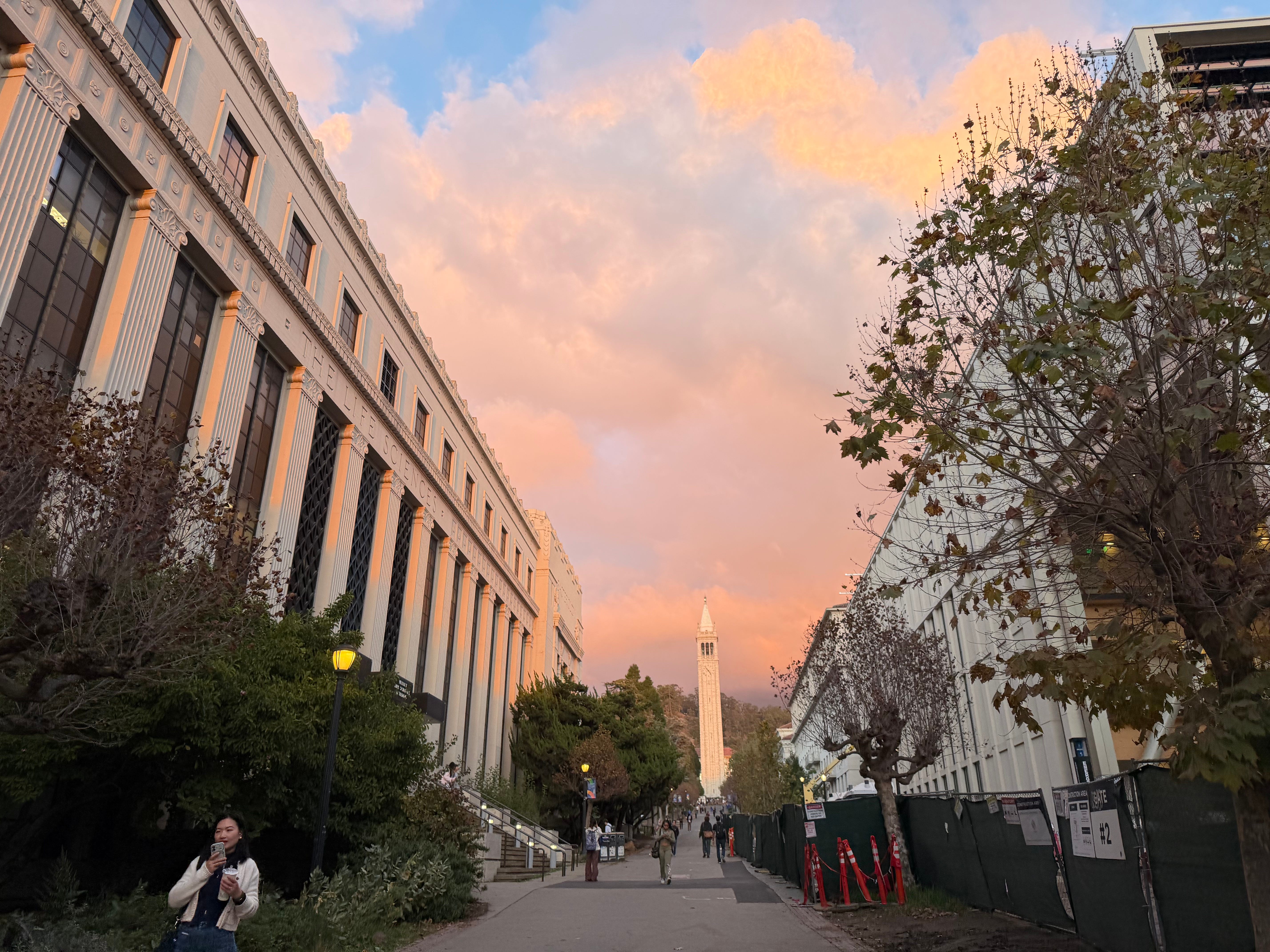
At the end of August, I began a PhD in English at Berkeley.
The PhD had been an aspiration since undergrad, but the advice I continually received was that I ought to take at least one year to really decide whether or not the PhD would be right. The three years I spent working various jobs and trying to scrounge together a scrappy little life for myself in the city were valuable years, and I’m glad I took the time—if only to feel, by the end, like I was choosing the better alternative for myself.
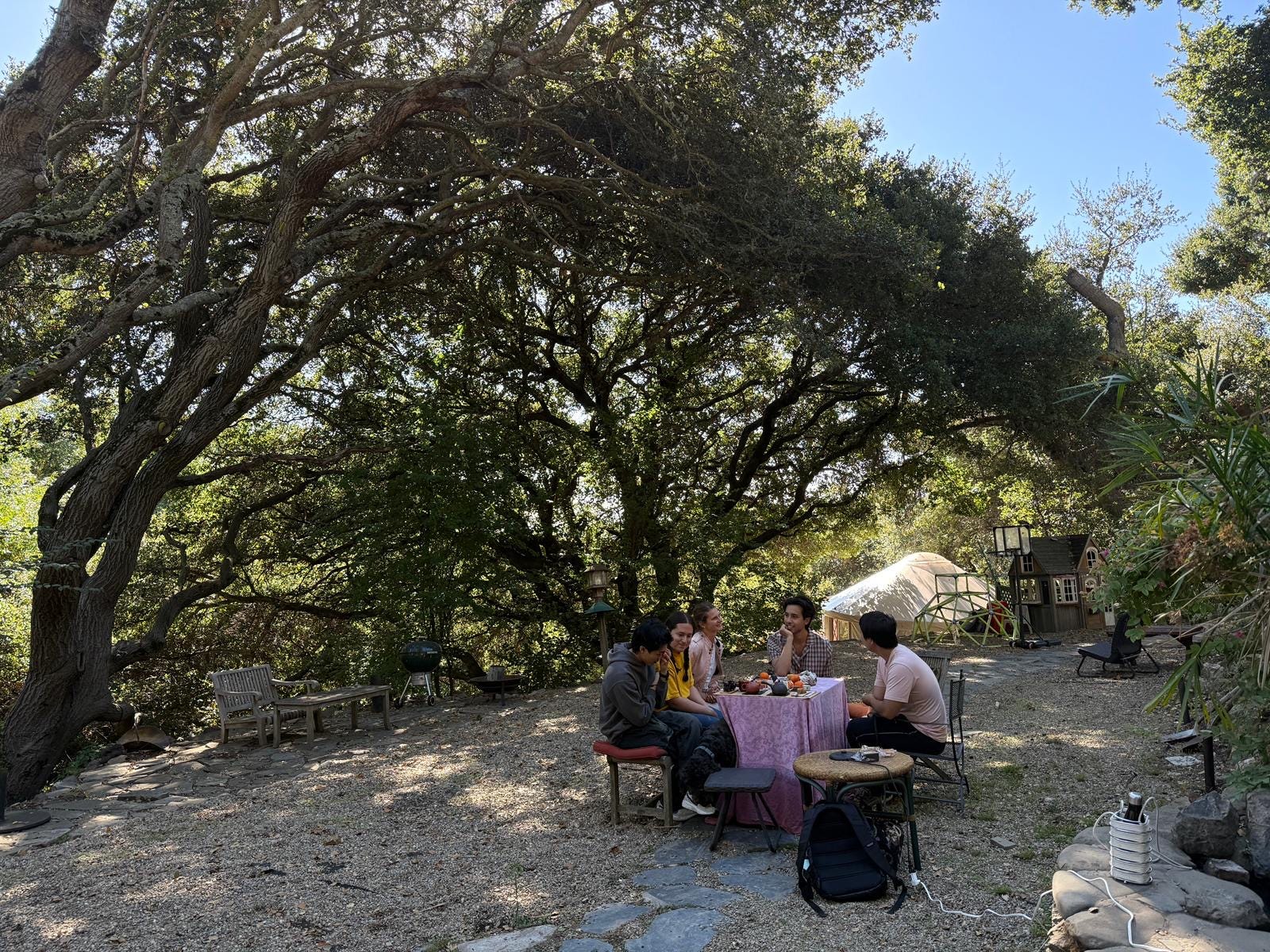
Life in Berkeley is peaceful and serene. I spend my days reading and writing, watching old movies or looking at interesting art for my classes, discussing fantastical ideas with friends, and meandering along sun-dappled pathways. Each day is the same—warm and sunny—and I have never tasted produce as fresh and flavorful as in California. Berkeley isn’t as exciting or glamorous as New York (I always feel overdressed), and I miss my friends dearly—most of whom still live in the city—but it is comfortable enough and for the most part, I feel content.
The greatest comfort afforded by my new residence in Northern California, however, is not material but sociological. UC Berkeley is 40% Asian, which makes Asians the largest represented demographic on campus, meaning that for the first time in my life, I am living in an Asian American-majority community. Even in San Francisco, which is still predominantly white, Asians consist of 37% of the population. Six out of the eleven members of my English PhD cohort are of Asian descent, and next semester, all of the classes I am currently enrolled in will be taught by Asian faculty members. I live a few paces away from the very building within which “Asian American” was coined, and there are bubble tea shops and noodle restaurants of all Asian cuisines nearly every block. Berkeley, for all intents and purposes, feels like the heartland of Asian America.
This ought to bring a greater degree of ease in my everyday interactions—and for the most part, it does, but as someone used to taking a defensive position, I find myself equally unsettled by this Asian Abundance. I still have a desire to distinguish myself from the other Asians around me, even as I yearn for their closeness and companionship; I still feel a need for people to know that I’m not like the other Asians.1
Perhaps this desire for distinction stems from the paradox of being a local majority within a national minority. If anything, California’s Asian Abundance exacerbates existing preconceived notions about who or what Asians are—that we multiple and proliferate in swarms, and therefore pose a threat to the other America.
Abundance suggests excess, and excess begets greater extremes on both ends. There is, on the one hand, Asian fetishization. “White-Asian couples are the most common dating pattern in the Bay,” a white guy mentioned to me on a date. “My cousin is slaying at life—he has an high-paying tech job and a hot Asian wife,” he added. I internally recoiled. Though I’m sure he offered the comment as a compliment, I resented how it implied that I would be a prize—some indication that he, too, was “slaying” at life, as though to acquire an Asian girlfriend was to signal some ascension on the male American achievement ladder.
Then, from the other end, there was also the resentment towards Asian flourishing. During a visit to the DMV, I explained to the woman assisting me that I was a student at Berkeley and needed to establish residency in California. She sighed impatiently and asked, “may I see your visa?” Visa??? I raged internally. But I am American! I wanted to yell. Instead, I brandished my passport like a weapon and slid it towards her. My first thought was that perhaps most of the Asians at Berkeley who came to the DMV to establish residency were international students; my second thought was that I did not want to be grouped together with those students because our circumstances were entirely different; and my third thought was, well didn’t that prove the point of all the pundits who decried the very foundation of Asian American studies to begin with, and if so then what the hell was I doing in this PhD program?
In May 1968, within a wood-shingled house on Hearst Avenue, Yuji Ichioka and Emma Gee—among others—founded the Asian American Political Alliance, marking the beginning of a nationwide Asian American Movement that brought together Americans previously divided by ethnicity. Berkeley would become a forerunner in the spread of ethnic studies throughout academia, and a place of pilgrimage for many prominent Asian American writers and scholars, from Maxine Hong Kingston and Theresa Hak Kyung Cha to Hua Hsu and Viet Thanh Nguyen. It was where two of my advisors from undergrad, both prominent scholars in Asian American studies, received their PhDs. The decision to commit to Berkeley was an easy one, then—if not for the sunshine and proximity to family, then because it would mean fulfilling a course of fate already determined by history.
And yet, I still carried a deep-seated insecurity about my own placement in the program—that I myself was a “diversity hire,” or that I was fulfilling some stereotype about Asians who only hang out with other Asians and only care about vaguely Asian things. My research was too self-interested, and therefore not rigorous enough.2 Every time I had to introduce myself and my work, I felt embarrassed. How many more Asian women who wrote about how angry, repressed, and melancholic we were did the world really need? It was humiliating to be so earnest and open about one’s own neuroses.
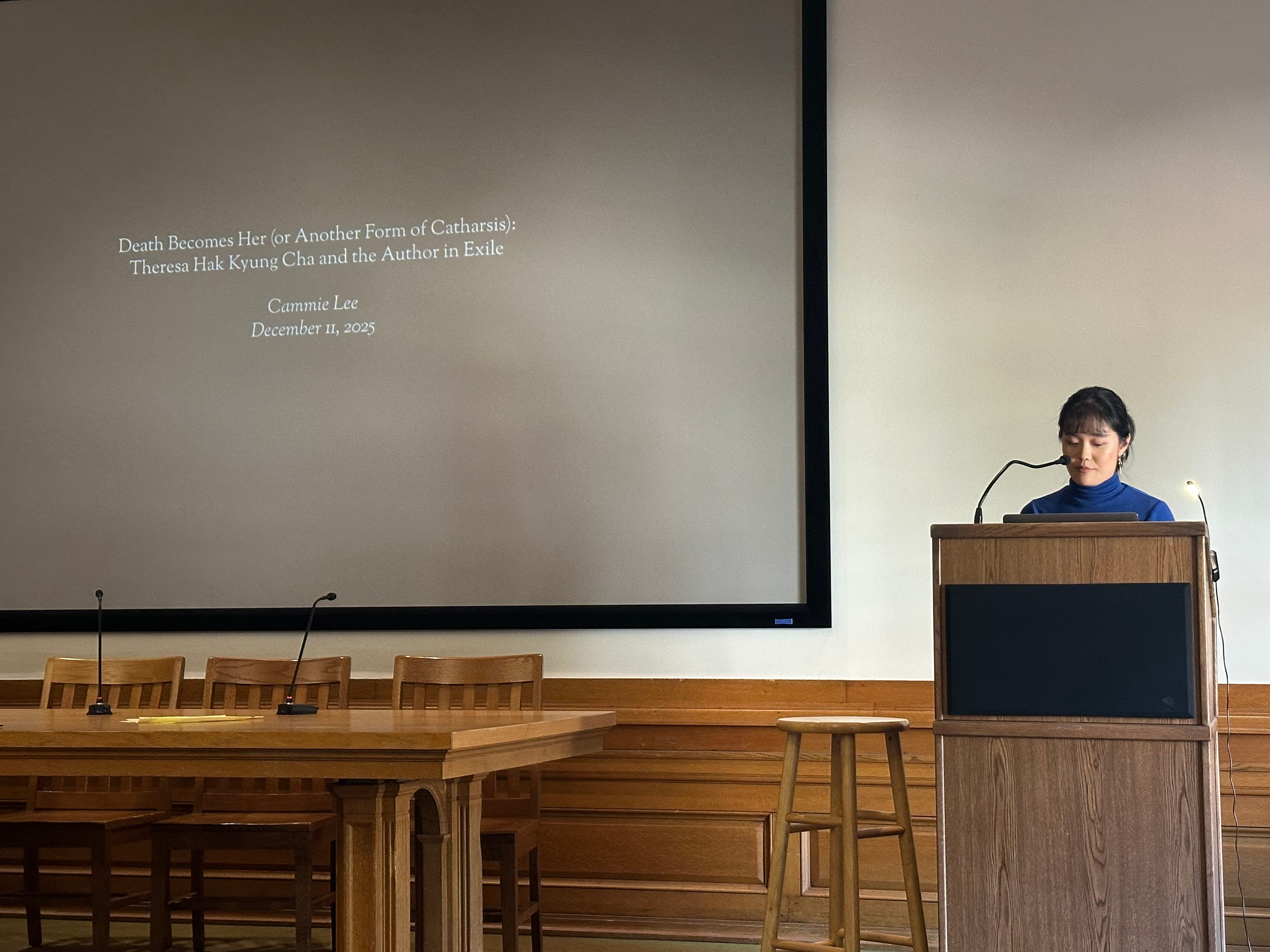
First-year English PhD students at Berkeley are required to take a proseminar on “Problems in the Study of Literature”—a survey course on theory and criticism that is meant to help students orient themselves in the field of literary studies. For this class, each student picks one text to work with for the entirety of the semester, about which they write four essays with a final “conference paper” that synthesizes the best parts of the three previous and is presented to other members of the department. The class is largely thought to be an inauguration into the program—a departmental hazing, if you will. The choice of the text and its presentation lands as a self-branding exercise of sorts—a vague signaling of one’s interests, methodologies, and periodization.
I ended up selecting as my text an edited collection of work by Theresa Hak Kyung Cha, who is most famous for her experimental autobiographical text Dictée. Cha attended Berkeley in the 70s, and received four degrees from the institution by the time she graduated in 1978. Her archives reside at the Berkeley Art Museum and Pacific Film Archive, and constitute the majority (over fifty percent) of the BAMPFA’s research requests. It seemed like the logical decision to write about Cha—well within my magical thinking of having fatefully arrived at Berkeley.
Midway through the semester, I confessed to our professor during office hours that I felt self-conscious about the incestuous navel-gazing of writing about Asian American topics. “You don’t have to worry about that anymore,” he reminded me. Still, I saw how many of my Asian American peers within my cohort were pursuing what I perceived as more universally humanistic interests, and could not help but feel as though something were wrong with me because I couldn’t seem to let go of my racial (and gender) resentment, that I was indeed wokefully blackpilled (if such a thing were possible).
The wound that gives me purpose and compels me to write is the same wound that makes me live in anguish. Writing is bloodletting, I once texted a friend. One perhaps needs to be a bit of a masochist to try and become a writer. It is, in the absence of anything else, the sole consolation. When it comes to being a critic, another professor of mine once said, “you have to have a strong sense of the aesthetic, of course, but you also must have a hint of social resentment, a dose of political spleen.” What was I to do if my awareness of the gaze of the world staring back at me made me miserable? Could I give it all up and return to the blissful ignorance of Plato’s cave?
Impossible. What I feared more than facing the gaze of the world was not knowing that I was being scrutinized, even if it did mean that I would be happier. Berkeley, anyhow, was a different sort of cave—a refuge from the horrors of the current political climate and the wind of terror sweeping through academia. “We keep hiring,” people said around me. “Our department enrollment numbers keep increasing,” others offered. California abundance, I thought. All things considered, it wasn’t so terrible a place to be a mediocre, melancholic writer.
During December, Berkeley hosted a conference dedicated to Marxism and Asian American Studies. Attendees ranged from present undergraduate and graduate students to members of the greater Bay Area community, many of whom had themselves been involved in the Asian American movement. Though the event felt a bit nostalgic, reminiscent of a previous era in Berkeley’s history—no one could seriously be convinced that the cadres of Asian Americans working in tech across the Bay would actually get behind any Marxist revolution today—I was energized by the utopic imagining of Asian America brought to life within that room, if only for a few hours. Asian Americans representative of all ages and ethnicities showed up, and though people cycled in and out throughout the day, the room remained full. It was Asian Abundance on full display—a luxury I could have never dreamed of in Portland or thought possible at Princeton.
Perhaps, by virtue of growing up in one of the whitest big cities in America, I will always be a bit of a “self-hating Asian,” as Cathy Park Hong wrote in Minor Feelings. I will never be able to waltz through life with the self-assuredness of my California Asian peers. But I can still try to savor my time at Berkeley now—and all the abundance that it has to offer.
Of which this Substack is in woefully aghast refutation, seeing that it is entirely Asian American coded. I’ve contemplated changing the name several times but seem unable (or unwilling) to find a better alternative…
This itself is a misnomer, given that any academic pursuit is largely self-interested, even if not explicitly coded as such.
aw 100% relate to this! I remember reading minor feelings and having a crisis like huh maybe I am a self hating asian
And this is my first time coming across the phrase Asian abundance, perhaps you coined it, keke cool. I see what you're saying, California does have beautiful abundance, and people's childhood experiences and observations are critical to them